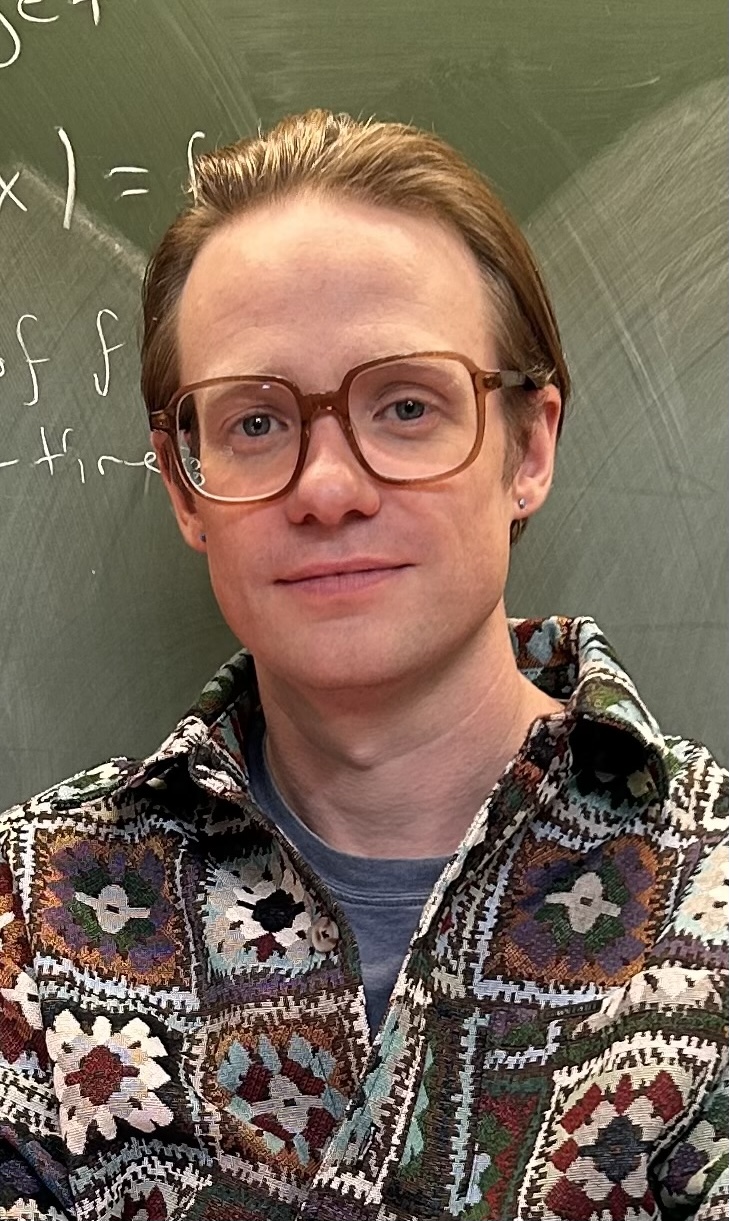
About Me
I am an Associate Professor in the School of Computer Science at McGill University. I am a theoretical computer scientist, which means that I use mathematical tools to study the nature of computational processes. My main research topic is computational complexity theory, although I am particular interested in the intersection of complexity and mathematical logic, through proof complexity and related topics. In SOCS, I run the Complexity Lab with Hamed Hatami.
You can look at my curriculum vitae for more of my (professional) past life, if you’re into that sort of thing. Otherwise, scroll on down to find my research papers, my graduate students, or my recent teaching.
contact
E-Mail: robert.robere@mcgill.ca
Coordinates: MC 309
McConnell Engineering
McGill University
Montréal, QC, Canada
News and Useful Info
Sabbatical, 2026–2027
I will be on sabbatical for the 2026-2027 academic year, and so will not be taking students or doing any undergraduate supervision.
Undergraduate advising
If you are a McGill undergraduate looking for advising from me, please read this first.
Research
Polynomial Interpolation for Sherali-Adams Lower Bounds
Nathan Acheampong, Ben Davis, Robert Robere
We prove Sherali-Adams is exponentially weaker than Res(2), and also that it is not automatable unless P = NP. This resolves an open question asked by many papers on the automatability of weak proof systems.
Submitted to STOC 2027.
Hard Instances for Strong Semantic Proof Systems: CNFs for Depth-Four PC and Deep Instances for \(AC^0\)[2]-Frege
Yaroslav Alekseev, Svyatoslav Gryaznov, Dmitry Itsykson, Toniann Pitassi, Robert Robere, Iddo Tzameret.
We extend recent lower bounds for the Res(+) proof system, due to Braun, to several semantic algebraic proof systems. We prove numerous lower bounds for these systems, and also exhibit a depth hierarchy theorem for \(AC^0[2]\)-Frege system for depth-\(d\) formulas.
Submitted to STOC 2027.
Progress on \(AC^0[2]\)-Frege Lower Bounds
Yaroslav Alekseev, Svyatoslav Gryaznov, Toniann Pitassi, Robert Robere, Alexander Shekhovtsov, Iddo Tzameret
We further improve the best known lower bounds against fragments of \(AC^0[2]\)-Frege proof systems, using techniques derived from the new exponential correlation bounds for polynomials by Chattopadhyay, Hatami, Lee, Lovett, Tal, and Viola. Our strongest bounds are superpolynomial for the fragment of depth-3.5 \(AC^0[2]\)-Frege proofs whose lines have the pattern \(\lor\land\oplus\land^{[b]}\), where \(b = o(\sqrt{\log n})\). Thanks to a known depth reduction of Buss, Kolodziejczyk, and Zdanowski, any polynomial-size \(AC^0[2]\)-Frege refutation can be reduced to this fragment in quasi-polynomial size where \(b = (\log n)^{O(1)}\). Hence our bounds are nearly at the threshold of what is attainable before proving lower bounds against arbitrary constant depth \(AC^0[2]\)-Frege.
Submitted to STOC 2027.
Lower Bounds Between Random CNFs and PRG Tautologies for Dag-like Communication
Duri Andrea Janett, Robert Robere, Anastasia Sofronova, Dmitry Sokolov
We prove new lower bounds on the length of Cutting Planes proofs for formulas which can be viewed as formally “between” random \(\Theta(\log n)\)-width CNFs, and PRG tautologies based on the Nisan-Wigderson generator. This requires developing a new technique for Cutting Planes lower bounds using the method of approximations, applied directly to the underlying triangle-DAG.
Submitted to STOC 2027.
Provable Reductions in TFNP
Noah Fleming, Stefan Grosser, Toniann Pitassi, Robert Robere
We develop a new approach to implicit proof systems using white-box TFNP classes. In our new theory, an implicit proof can be viewed as a many-one reduction from the false-clause search problem associated with an unsatisfiable CNF formula to a problem in TFNP, coupled with an Extended Frege proof that the reduction is correct. Using this, we prove a new characterization of implicit Resolution, resolving an open problem posed by Krajicek.
To appear at ITCS 2027.
Lower Bounds for Approximate Sign-Rank
Riju Bindua, Hamed Hatami, Hasti Karimi, Robert Robere
We develop a new technique for proving lower bounds against approximate sign rank, which is a randomized variant of sign-rank introduced in the context of learning theory by Chornomaz, Moran, and Waknine. Formally, we show that any \(m \times n\) sign matrix with approximate sign-rank \(d\) contains a monochromatic rectangle of size \(d^{-O(d)} \times d^{-O(d^2)}\), which parallels existing results for sign rank. As a result, we obtain the first super-constant lower bounds for approximate sign-rank, as well as obtaining strong separations between approximate sign-rank and regular sign rank.
The key ingredient of our proof is a new geometric theorem on hyperplane avoidance, which we believe to be of independent interest.
To appear at ITCS 2027.
The Lab
current students
- Hasti Karimi, MSc Student (2025-Present). Co-advised with Hamed Hatami.
- Riju Bindua, PhD Student (2025-Present). Co-advised with Hamed Hatami.
- Isabelle Champion, MSc Student (2025-Present).
- Ben Davis, PhD Student (2024-Present).
long-term visitors
- Jonas Conneryd, Lund University. (Summer 2026)
- Duri Janett, University of Copenhagen. (Spring 2026)
- Jiawei Li, UT Austin. (Summer 2024).
- Erfan Khaniki, Institute of Mathematics of the Czech Academy of Sciences. (Fall 2023).
- Yuhao Li, University of Columbia. (Summer 2023).
alumni
- Svetla Vassileva, MSc Student (2023-2026). Instructor at Champlain College St-Lambert.
- Stefan Grosser. PhD Student (2021-2026). Postdoctoral researcher at Oxford University .
Teaching, Current and Future
- On sabbatical in the 2026-2027 academic year.
Fun
- - I was born and raised in St. John’s, Newfoundland, which is the best place on earth. When I was 22 I moved away for graduate school and, as you can see from the picture, this was obviously a mistake.
- - Speaking of which, you might be looking for my Dad — also named Robert Robere — who is a house designer in St. John’s. His website is here.
- - I do a lot of rock climbing! I’m even on Mountain Project (light blue shirt). Places I’ve climbed include: Red Rocks, Yosemite, Utah, The New River Gorge, The Gunks, Newfoundland, and essentially every crag in Southern Ontario and around Princeton, NJ.
- - Before graduate school I was heavily involved in theatre. As a student I performed with (and then later taught many workshops for) the Canadian Improv Games in Newfoundland. I was also a founding member of the theatre group Stanley Braxton, which is still running today!
